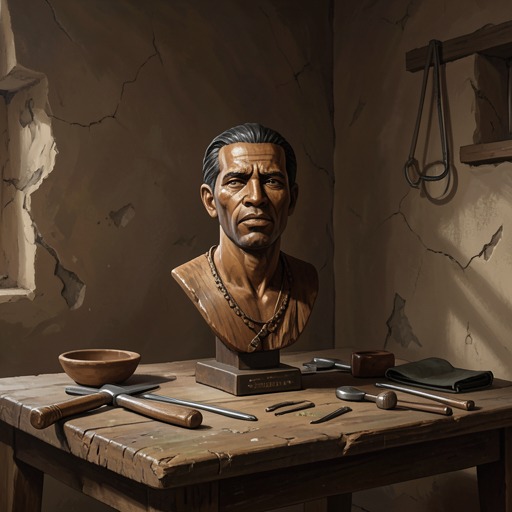
Wooden bust of Holly
Breakfast at Tiffany'sThe Wooden bust of Holly is a carved likeness of Holly Golightly that surfaces in three photographs brought to Joe Bell. Its resemblance offers an arresting, material clue to Holly’s possible passage through a remote village, but the account attached to it cannot establish her identity or whereabouts with certainty.
Appearance and Discovery
The photographs, taken from different angles, show a tall, delicate Black man in a calico skirt holding an elongated wooden carving of a girl’s head. The carved girl has sleek, short hair, oversized tilted eyes, a tapering face, and a wide, overdrawn mouth. At first the head resembles primitive carving; on closer inspection, it looks unmistakably like Holly. The narrator agrees that it looks like her, while Joe Bell insists the likeness is exact.
The reverse of one photograph identifies the object as a wood carving from the S Tribe at Tococul, East Anglia, dated Christmas Day, 1956. This caption anchors the bust to a specific place and day, but it does not explain how Holly came to be represented there. The photographs give the resemblance a physical presence; they do not make the story behind it firsthand evidence.
The Account of Its Making
As relayed by Joe Bell from I. Y. Yunioshi, the carving was encountered during a photographic passage through Tococul. Yunioshi saw the man carving monkeys on a walking stick and asked to see more of his work. The man then showed him the girl’s head. Yunioshi was so struck by it that he felt as if he were falling in a dream, and he tried repeatedly to buy it. The carver refused offers that included salt, money, and a wristwatch; Yunioshi eventually paid with salt and his watch to learn how the carving came to be made.
The explanation, pieced together through African languages, rudimentary English, and gestures, placed the carving’s origin in the spring of that year. Three white travelers on horseback had emerged from the brush: a young woman and two men. The men, feverish, spent weeks shut away and shivering in an isolated hut. The young woman, according to the story, took a fancy to the woodcarver and shared his mat. Later she left as she had arrived, riding away on a horse. The account is hearsay, and Joe Bell explicitly doubts its intimate detail; he guesses that she departed with the two men.
Evidence, Uncertainty, and Significance
The bust matters because it is more than another rumor: it is a concrete likeness tied to a dated photograph and a named village. Yet its evidentiary force has limits. The only direct identification is visual, while the tale of the travelers reaches Joe Bell through Yunioshi and a chain of translation. When Yunioshi asked about the woman across the surrounding country, nobody else had seen her. The object therefore supplies a location and a possible episode without resolving whether Holly was there.
For the narrator, the carving makes the distant account imaginable: although he believes Holly probably never set foot in Africa, he can picture her in such a place and returns his attention to the photographs. For Joe Bell, it is the only definite news of her in years, enough to hope she is rich, but not enough to answer where she is. The bust’s likeness is vivid; the life it seems to attest remains out of reach.